
Artist Profile Nick Leeper
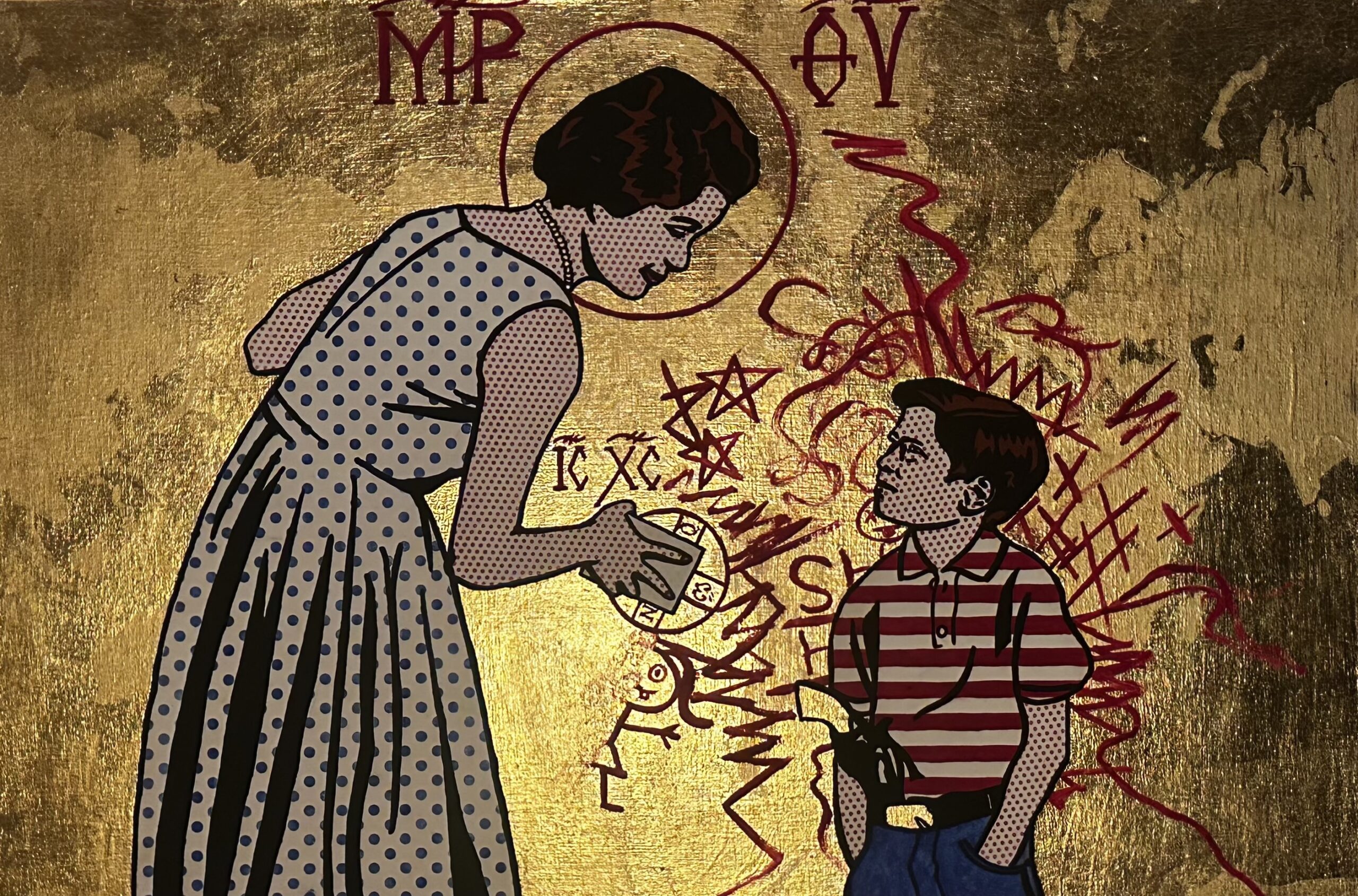
Nick Leeper, Madonna and Child (Laudato No), 2025, Acrylic, ink, and gold leaf on linen panel, 30″ x 20″ (762 mm x 508 mm).
Leeper’s strikingly layered icons resolve material chaos with sacramental grace.
Artist Statement
The gold-leaf expanse in Madonna and Child does not merely recall the sacred space of Byzantine iconography and the heavenly realm—it asserts itself as a cosmic stage upon which the eternal and the earthly collide. The very map of the world – fragile, wounded, yet a distinct part of – this eschatological vision. This is not merely the timeless, incorruptible plane of the divine; it is intertwined with the world, elevating our planet to a sacred space. The world, despite its imperfection, pollution, and defecation, does not stand apart from the holy. It is pressed into the sacred. Both exist on the same beatific plane.
A mother, haloed, bends toward her child, erasing, restoring, and intervening. Her polka-dotted dress belongs not to the traditional icons but to the mundane world of mid-century domesticity, suburban idealism, and mass consumption, which have, in their own way, left their mark on our planet. But if her garments are common, her gesture is anything but. This is no mere maternal correction; it is an act of cosmic significance.
Before her, the child stands—a small figure, yet already in rebellion. He has scrawled across the sacred gold, marking it with symbols of chaos, play, and defiance. His graffiti is a world unto itself—a universe conjured from restless hands. And in this reckless act, has he not, in some way, mirrored our marks upon creation itself? Is he not also playing a demiurge, imposing a new world upon another? And yet, his crown is unsteady, his authority self-proclaimed. He is the image of humanity: willful, restless, destructive—capable of desecration while striving to be like God in the same breath. Yet, this child’s face remains ambiguous. Is he resisting this purification or longing for it?
And what is the mother’s response? She wipes away the careless doodles on our environment caused by her child out of the unsatisfied ennui that plagues modern life. She invites him toward something higher, an order he does not yet understand. The act of cleansing, then, is no simple gesture—it is a reckoning. The sacred does not merely descend; it demands. The child has defiled the divine domain, but the saints do not turn their backs on him. Christ does not banish him but takes away the sins of his world.
If Laudato Si calls for a renewal of our common home, this work reveals this through mid-century modern myth. Here, in the smallest of acts—a mother wiping away the errant marks of her son—lies the entire question of humanity’s fate. Can the world be redeemed? Who will come to clean up our errant behavior upon the world? Or will it succumb to its own disorder, its own unrestrained hand? To cleanse is to see again the world how God created it—as good. To cleanse is to learn to remove the noise in order to see the world in its sacredness once again and realize our call to care for it, not dominate it.
The mother and child, locked in this moment, embody the eternal tension between chaos and order, creation and destruction, will and grace. And if the mother’s hand is a hand of discipline, it is also one of mercy. For she does not scowl but gently and calmly removes his graffiti with the cleansing power of Christ. She washes. She restores. And in doing so, she enacts the great work of redemption—not in fire, not in thunder, but in sacramental soap and sponge—in the quiet insistence that the world, however marred, is still worth saving.
Artist Biography
Nick Leeper (b. 1992, New Jersey, USA) is a person who happens to teach, make pop icons, and be a Jesuit. His work combines traditional icon writing with contemporary pop art techniques that explore the interplay between the sacred and the profane. Nick’s work delves into themes of nostalgia and imagination, often incorporating commercial advertisements to challenge an audience’s sacral awareness. Born in 1992 in New Jersey, USA, Leeper barely holds an MA in Philosophy from Saint Louis University, St. Louis, Missouri, USA. He has had works displayed at venues, including bodegas, halfway homes, donut shops, and various galleries. His work is in a variety of private collections in the United States. Leeper currently lives and works in Manhattan, New York.