
Artist Profile Jeremy Davis
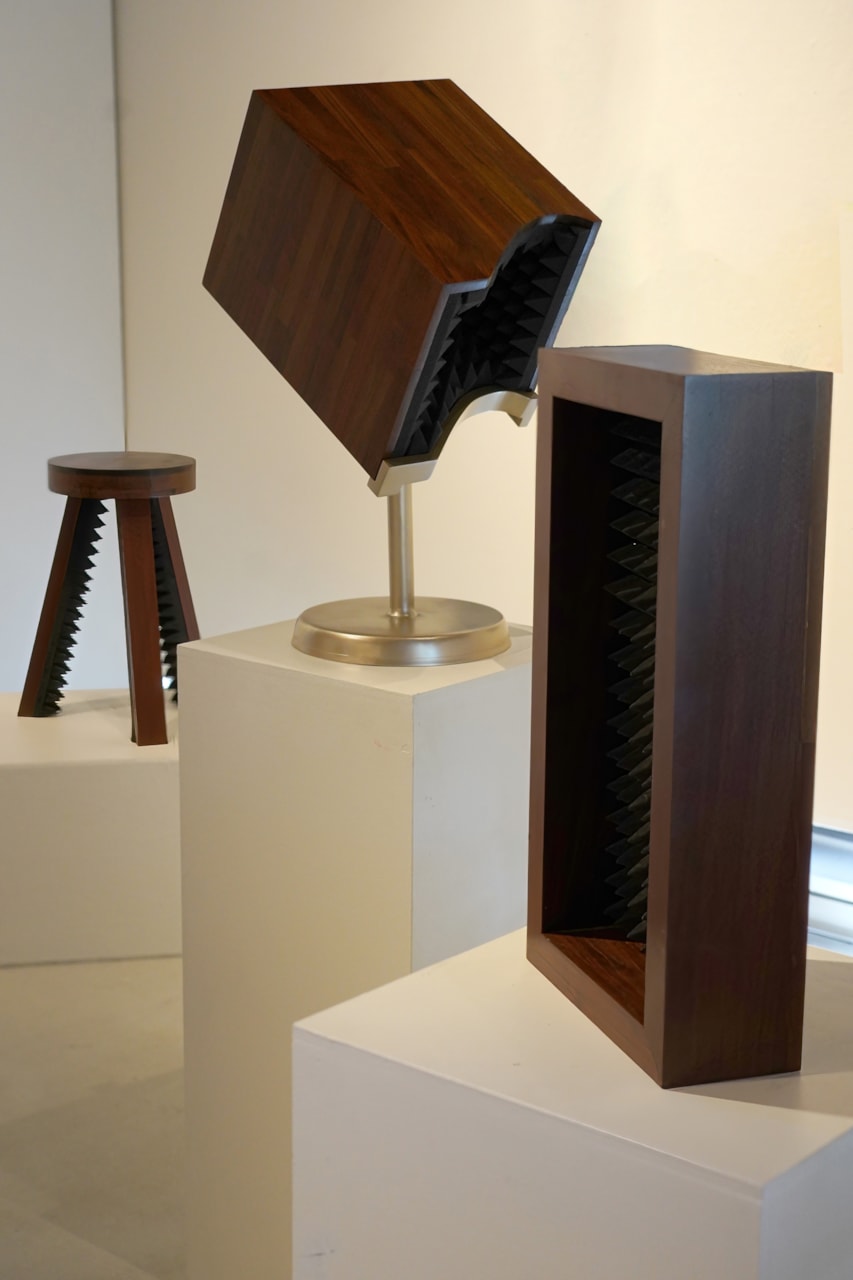
Jeremy Davis, The Crying Place, 2023, Ipe wood, anechoic foam, bronze, Group of 3, each approx. 8″ x 30″ x 30″ (203 mm × 762 mm × 762 mm).
Davis’s exquisitely crafted anechoic sculptures offer a sanctuary for release and vulnerability.
Artist Statement
This work imagines well-being via a portable safe space entitled The Crying Place. It was inspired by my own inability to cry in public. To do so would cause me to feel inexplicable shame, even though I know it is ok. I was raised to feel this way. I made this because I needed a place to feel emotions in public. Perhaps others do too. This group of three pieces of furniture is made of one of the densest woods in the world, lined with anechoic foam. No sounds escape, no sound enters. The mirror does not reflect. The stool does not betray the sitter. There is no shame. This sculpture group invites the viewer to consider the weight of their emotions, their willingness to hide them, by also announcing that emotions are being had. Unlike the myth of the ostrich with its head in the sand, the wearer does not hide and expect to be hidden. They need others to know they have feelings.
Much can be said by saying very little—and I hope my work speaks for itself. I’m drawn to the power of sound, especially when paired with form. When an object is given agency through sound, it becomes something more intimate, something capable of reaching us in ways the visual alone cannot. Unlike sight, hearing is involuntary—you can always look away, but you can’t close your ears. That vulnerability creates a space for deep connection.
I work at the intersection of sound, sculpture, and time. My interest lies in the space between a sound’s origin and its reception—between the object that makes the sound and the listener nearby. That space, however brief, is charged with energy. It mirrors the distance between people, the pause between thoughts, or the silences that follow difficult truths. Sound requires time to exist, and it marks time as it moves. It surrounds us, resonates within us, and lingers. This passage of energy is where the art lives for me. To perceive is to be affected, and to be affected is to change.
A lifelong musician, I’ve always felt that my visual work isn’t complete without sound. Early on, I composed original audio to accompany traditional sculpture, often casting clay models into resin or bronze. That evolved into casting metal directly into wooden instruments to investigate the source of sound itself—melding materials that contain their own musical histories. I began using the raw components of instruments not just as materials, but as potential energy: latent sound waiting to be released.
Recently, I’ve embraced technology to create interactive “Magic Boxes” that emit programmed tones, pulses, or compositions—sound emerging without visible source. These pieces blend digital precision with the intimacy of analog resonance. I’m now expanding into new media, particularly video and audio recording, to explore how time, perception, and memory intersect through sound.
Formally, my work is experimental and hybrid—fusing traditional methods with contemporary tools to shape experiences that invite listening as much as looking. I gravitate toward moments that are both serious and humorous, uncanny and familiar. The work isn’t meant to be didactic; rather, it invites you into a shared sensory space where meaning is felt more than told.
Looking ahead, I’m committed to deepening my exploration of sound in the visual arts and developing new forms that emphasize listening as a primary mode of experience. Sound is still an underexplored medium in contemporary sculpture, and I believe it holds vast potential to connect us—to memory, to presence, and to each other. Through resonance, both literal and metaphorical, I aim to build spaces that feel alive, responsive, and human.
Artist Biography
Jeremy Davis is a sculptor and educator originally from West Texas, where his artistic journey began with a passion for music and a formative discovery of Michelangelo’s work in his high school library. This early inspiration led him to pursue sculpture, eventually working at a bronze foundry before relocating to Connecticut to study at the Lyme Academy College of Fine Arts, immersing himself in classical techniques and traditions.
After spending over a decade in New England as a part-time instructor, studio assistant, and mold maker, Davis moved to Chicago to attend the School of the Art Institute of Chicago (SAIC). There, he collaborated with numerous prominent contemporary artists and created work that explores the intersection of sound and visual art, pushing the boundaries of traditional sculpture. Following the completion of his MFA in 2015, Davis taught at SAIC before accepting a position at Central Michigan University, where he now serves as an Associate Professor of Art. His current practice remains multidisciplinary and experimental, grounded in material exploration and a deep interest in how form, space, and sensory experience can communicate meaning and challenge assumptions.