
Artist Profile Jess Driver
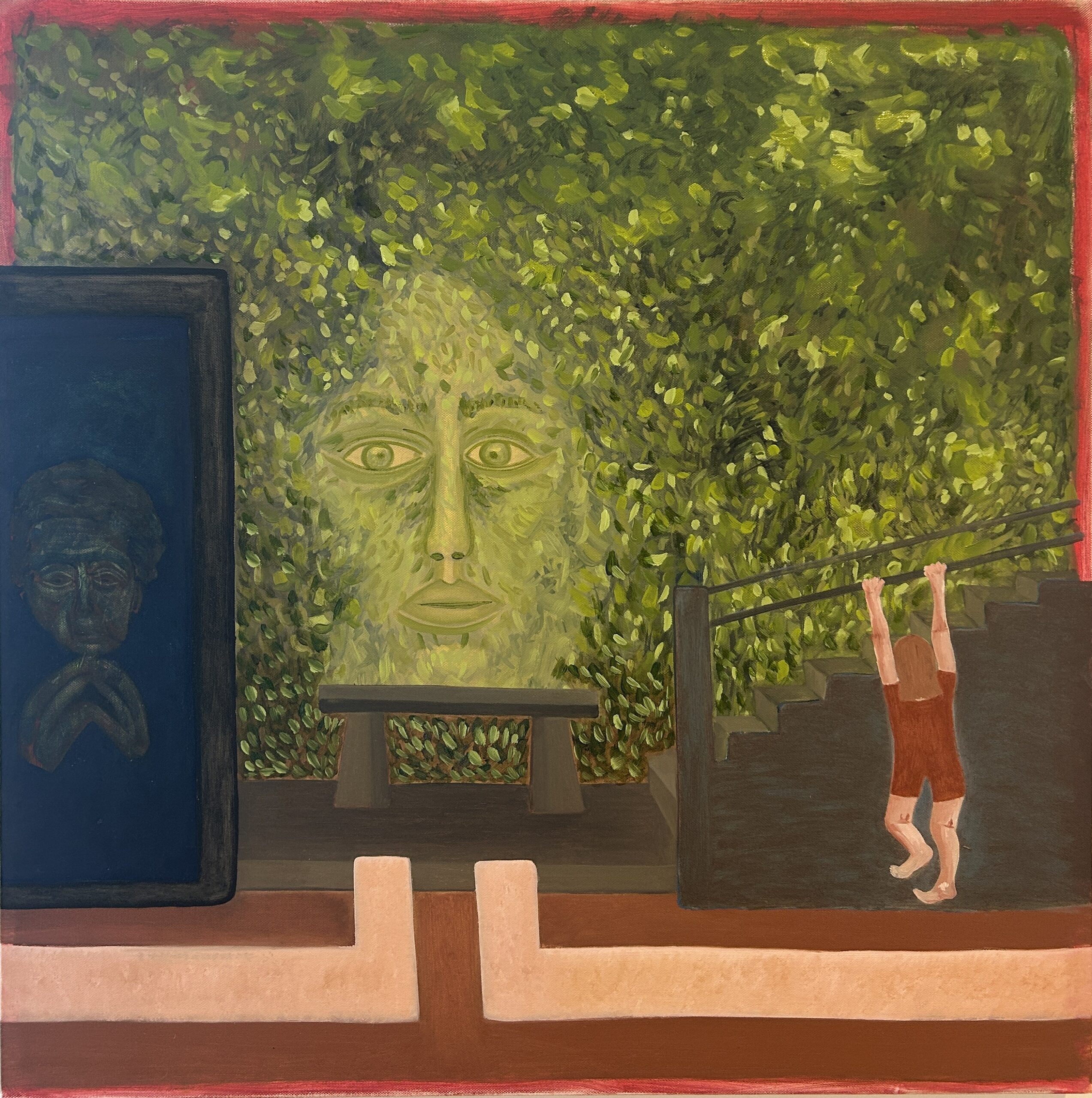
Jess Driver, Thresholds, 2025, Oil on canvas, 30″ x 30″ (760 mm x 760 mm).
Driver’s atmospheric, surreal paintings employ suspended figures and watchful landscapes to elegantly interrogate the nature of our collective ecological anxiety.
Artist Statement
This painting stages a moment of impossible effort. A small figure hangs from a rail, suspended between rising and falling — neither climbing the stairs nor letting go. The body is stretched, tense, caught in a gesture that is both determined and desperate. It is the posture of someone trying to hold on in a world that is shifting beneath them.
A staircase that leads upwards but blocked by effort, a railing that can be grasped but not mastered, a doorway that is revealed but not open and a world of foliage that watches but does not intervene. To the left, a dark doorway contains another face — one rendered in warm colours and deep shadows — representing an older self, a warning, or a former guardian now trapped behind glass, standing as a threshold that leads nowhere, or perhaps a reminder of what has already been lost.
This is a portrait of climate-era struggle: the feeling of trying to lift oneself into a future that no longer offers clear steps, while the past flickers in dark corners and the natural world judges quietly from its overgrowth. The figure hanging from the rail is both a child and a metaphor — the last part of us still trying, still insisting on movement in a time defined by waiting.
Artist Biography
Jess Driver is a New Zealand–based painter whose work navigates the emotional and psychological landscape of living in a world marked by environmental uncertainty and collective hesitation. Through a distinctive figurative language, working in oil paint, Driver creates scenes where bodies appear suspended, burdened, or deep in contemplation, inhabiting spaces that drift between the real and the surreal. Her paintings often centre on characters caught in moments of pause — hanging, carrying, waiting — gestures that become metaphors for the wider paralysis of our time, the moments where action fails to arrive — where people hold their breath, brace themselves, or simply endure.
Driver blends muted, earthen tones with dreamlike atmospheres to explore themes of climate grief, generational inheritance, loneliness, and neglect. Climatic scenes appear not as spectacle but as atmosphere: overgrown foliage that watches, skies heavy with memory, landscapes that seem conscious of our presence yet indifferent to our survival. Faces emerge from trees, doorways, and clouds like ghosts of the future or remnants of the past. They observe without intervening, embodying the paralysis that defines this era.
Deeply invested in the relational tensions between humans and their psychological landscape, the burdens we carry from the past, the expectations placed upon the present, and the uncertain futures we brace ourselves for. Rather than depicting ecological disaster directly, Driver paints its psychological residue — the weight, the waiting, the quiet endurance required to navigate it.